
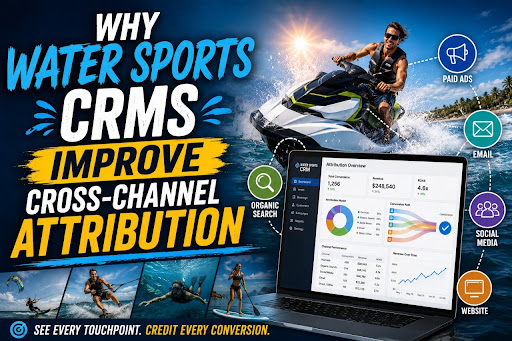
Water sports and tour operators rarely generate customers from a single marketing channel. A traveler might first discover a jet ski rental through Instagram, search the company on Google several days later, click a paid advertisement, visit the website twice, and finally call to make a reservation.
Without connected customer data, the business may give all the credit to the final interaction while overlooking the channels that actually introduced and influenced the customer.
A Water Sports CRM can help connect marketing and customer information across multiple touchpoints, giving operators a clearer picture of how advertising channels contribute to leads, bookings, and revenue.
For high-volume water sports businesses, better attribution can lead to smarter marketing decisions and more efficient advertising budgets.
Why Attribution Is Difficult for Water Sports Businesses
The typical customer journey isn’t linear.
Someone planning a vacation may research activities for days or weeks before booking.
Their journey could look like:
Instagram → Google Search → Website → Retargeting Ad → Phone Call → Booking
Another customer might follow:
Organic Search → Website → Email → Google Ads → Online Reservation
If each marketing platform is evaluated independently, multiple channels may claim responsibility for the same customer.
Cross-channel attribution attempts to create a more complete picture.
What Is Cross-Channel Attribution?
Cross-channel attribution is the process of understanding how different marketing interactions contribute to a customer conversion.
Channels may include:
-
Google Ads
-
Organic search
-
Facebook
-
Instagram
-
Email marketing
-
Direct website traffic
-
Referral websites
-
Phone calls
-
Retargeting campaigns
Rather than looking only at the final click, attribution examines the broader customer journey.
Why Last-Click Attribution Can Be Misleading
Last-click attribution gives conversion credit to the final marketing interaction before the customer converts.
Consider a traveler who:
-
Discovers your parasailing company through Instagram.
-
Searches your brand on Google.
-
Visits your website.
-
Leaves without booking.
-
Clicks a Google Ads remarketing campaign.
-
Makes a reservation.
A last-click model might give Google Ads all the credit.
But Instagram played an important role in creating initial awareness.
Understanding both interactions provides a more complete picture of marketing performance.
How a Water Sports CRM Connects Customer Data
A Water Sports CRM can serve as a centralized location for customer and lead information.
Depending on the CRM and integrations used, operators may be able to connect information involving:
-
Lead sources
-
Contact forms
-
Phone calls
-
Email conversations
-
Reservations
-
Customer details
-
Marketing campaigns
-
Sales outcomes
Instead of evaluating marketing platforms completely independently, businesses can connect more of the customer journey to actual lead and booking records.
Connect Marketing Leads With Actual Bookings
Generating a lead isn’t the same as generating revenue.
Suppose two campaigns each produce 100 leads.
Campaign A generates 20 bookings.
Campaign B generates 45 bookings.
If marketers only compare cost per lead, Campaign A might initially appear more efficient.
Once CRM booking data is considered, the picture can change dramatically.
The most valuable campaign isn’t always the one producing the cheapest leads. It’s the one producing profitable customers.
Track Google Ads Beyond the Initial Conversion
Google Ads may record actions such as:
-
Phone calls
-
Form submissions
-
Online reservations
-
Website interactions
However, many water sports businesses still need employees to convert inquiries into actual bookings.
Connecting advertising information with CRM records can help answer questions such as:
-
Which campaigns generate qualified inquiries?
-
Which keywords generate bookings?
-
Which ads attract high-value groups?
-
Which leads actually become customers?
This provides considerably more context than simply counting form submissions.
Measure Paid Social More Accurately
Social media can play a major role in travel inspiration.
A traveler scrolling through Instagram may see a video of:
-
Jet skiing
-
Parasailing
-
Snorkeling
-
Swimming pigs
-
Boat charters
-
Paddleboarding
They may not book immediately.
Instead, the advertisement introduces the experience and starts the research process.
CRM-supported attribution can help marketers evaluate social media’s influence even when another channel ultimately receives the final conversion.
Understand the Role of Organic Search
Organic search can contribute throughout the customer journey.
Potential customers may search phrases such as:
-
Jet ski rentals near me
-
Best snorkeling tours
-
Private boat charter
-
Parasailing near my hotel
-
Things to do on vacation
They may visit informational pages before returning through another channel later.
A broader attribution strategy helps prevent organic visibility from disappearing simply because another source captured the final click.
Track Phone Calls
Phone bookings remain important for many tourism and water sports businesses.
Customers may call because they have questions about:
-
Age requirements
-
Group sizes
-
Weather
-
Transportation
-
Availability
-
Safety
-
Pricing
-
Tour duration
Call tracking integrated appropriately with CRM workflows can help connect those conversations to marketing sources and eventual bookings.
Track Website Forms
Contact forms can provide another important connection point.
Forms may collect information such as:
-
Name
-
Contact details
-
Requested activity
-
Preferred date
-
Group size
When form submissions enter the Water Sports CRM, the business can track what happens afterward.
Did the lead receive a response?
Did the customer book?
How much revenue did the booking generate?
Those downstream outcomes are essential for evaluating marketing quality.
Connect Online Reservations
For operators offering direct online booking, reservation data can be particularly valuable.
Marketing attribution becomes much more useful when campaign information can be connected to:
Clicks → Reservations → Revenue
Instead of optimizing toward superficial engagement, businesses can focus on marketing that produces actual bookings.
Measure Revenue by Marketing Channel
Lead counts only tell part of the story.
Imagine three channels:
|
Channel |
Leads |
Bookings |
Revenue |
|
Paid Search |
200 |
70 |
$24,000 |
|
Paid Social |
300 |
45 |
$18,000 |
|
Organic Search |
150 |
65 |
$27,000 |
If the business evaluated lead volume alone, paid social would appear strongest.
Revenue tells a different story.
CRM attribution can help businesses evaluate channels based on outcomes closer to actual business value.
Identify High-Value Customers
Not every booking is worth the same amount.
One customer might reserve a single jet ski for a short period.
Another might book:
-
Multiple jet skis
-
A private boat charter
-
A large group excursion
-
Several activities
A Water Sports CRM can help marketers identify which acquisition sources produce higher-value customers rather than simply higher lead counts.
Understand Group Booking Value
Group bookings can be especially important for water sports businesses.
Bachelor parties, family vacations, corporate groups, wedding parties, and cruise groups may generate significantly more revenue than individual reservations.
Tracking these customers through the CRM can reveal which marketing channels consistently attract larger groups.
That insight can influence future advertising decisions.
Improve Customer Acquisition Cost Calculations
Customer acquisition cost becomes more meaningful when it’s based on actual customers rather than raw inquiries.
A simplified calculation is:
Customer Acquisition Cost = Marketing Spend ÷ New Customers Acquired
If a business spends $10,000 and generates 100 actual customers, its acquisition cost is $100 per customer.
CRM data can make this calculation more reliable by connecting advertising spend with actual booking outcomes.
Compare Cost per Lead With Cost per Booking
Cost per lead is useful, but it can hide lead-quality differences.
Suppose:
Campaign A: $20 per lead, $120 per booking
Campaign B: $35 per lead, $80 per booking
Campaign A produces cheaper leads.
Campaign B produces cheaper customers.
Without tracking downstream conversions, marketers might incorrectly reduce Campaign B’s budget.
Measure Return on Ad Spend
For businesses capable of connecting marketing spend with booking revenue, return on ad spend can provide another useful performance indicator.
Rather than asking only:
“How many leads did we get?”
operators can ask:
“How much tracked booking revenue did this campaign generate relative to advertising spend?”
That is a much more useful question for budget allocation.
Identify Assisted Conversions
Some channels introduce customers without closing them immediately.
These are often called assisted interactions or assisted conversions.
For example, social media may generate awareness while paid search captures the later booking.
If businesses only evaluate final-touch performance, awareness channels can appear less valuable than they actually are.
Cross-channel attribution provides additional context.
Understand the Full Customer Journey
A customer’s path might involve numerous interactions:
Facebook Ad → Website → Google Search → Blog Post → Email → Retargeting → Booking
A CRM doesn’t magically make every attribution challenge disappear.
However, centralized customer records can make it easier to connect available marketing information with actual customer outcomes.
That creates a stronger foundation for analysis.
Improve Retargeting Campaigns
Not every website visitor is ready to book immediately.
Someone may be:
-
Comparing tour operators
-
Checking prices
-
Waiting for travel dates
-
Coordinating with friends
-
Researching weather
-
Planning a cruise stop
CRM and marketing integrations can help businesses develop more informed follow-up and retargeting strategies where appropriate and compliant.
Improve Email Marketing Attribution
Email is another channel that can influence bookings without always receiving obvious credit.
A traveler may subscribe or inquire, receive an email, and later return directly to the website to book.
Without connected data, the final reservation may appear as direct traffic.
CRM records can provide additional context about the customer’s earlier interactions.
Track Repeat Customers
Attribution shouldn’t stop after the first booking.
A customer who rents a jet ski this year may return next year for a private charter.
A CRM can help identify:
-
Repeat customers
-
Previous activities
-
Booking history
-
Customer value over time
This makes it possible to think beyond one transaction and consider longer-term customer value.
Understand Customer Lifetime Value
Customer lifetime value can be particularly important for businesses with repeat visitors or multiple services.
A customer initially acquired through an expensive campaign might appear unprofitable after one transaction.
If that customer returns multiple times or books additional activities, the acquisition may ultimately be highly valuable.
A Water Sports CRM helps preserve the customer history needed to evaluate these longer-term relationships.
Improve Marketing Budget Allocation
Better attribution can lead directly to smarter budgeting.
Instead of allocating advertising money based primarily on clicks or platform-reported conversions, operators can examine:
-
Qualified leads
-
Booking rates
-
Revenue
-
Customer acquisition cost
-
Repeat bookings
-
High-value customers
Budgets can then be shifted toward channels producing stronger business outcomes.
Find Underperforming Channels
Cross-channel attribution can also expose weaknesses.
A campaign might generate plenty of traffic but very few bookings.
Possible reasons could include:
-
Weak targeting
-
Low-intent audiences
-
Misleading ads
-
Poor landing pages
-
Pricing mismatches
-
Slow follow-up
CRM data helps marketers investigate where the customer journey is breaking down.
Measure Lead Response Time
Marketing performance isn’t determined solely by advertising.
Operations matter too.
If a high-quality lead submits a request but waits six hours for a response, the customer may book with a competitor.
A CRM can help businesses monitor:
-
When leads arrive
-
When employees respond
-
Whether follow-up occurs
-
Whether leads convert
This can reveal whether poor conversion rates are actually a marketing problem or a sales-process problem.
Improve Sales and Marketing Alignment
Without a shared system, marketing may celebrate lead volume while the reservations team complains that the leads are poor quality.
A CRM creates a common source of information.
Marketing teams can see what happens after acquisition, while sales or booking teams can understand where inquiries originated.
This helps both teams focus on the same outcome: profitable bookings.
Use Attribution Data for Seasonal Planning
Water sports demand can change significantly throughout the year.
Marketing performance may vary according to:
-
Tourist seasons
-
Holidays
-
School breaks
-
Cruise schedules
-
Weather
-
Local events
Historical CRM data can help operators identify which channels performed well during specific periods.
Those insights can inform future seasonal campaigns.
Compare Activities Separately
Different activities may require different marketing strategies.
Someone searching for a private yacht charter may behave very differently from someone looking for an inexpensive paddleboard rental.
Operators should consider analyzing attribution by service.
Examples include:
-
Jet ski rentals
-
Boat charters
-
Snorkeling
-
Parasailing
-
Kayaking
-
Paddleboarding
-
Fishing
-
Island tours
This prevents performance from being hidden inside broad company-wide averages.
Track Source Data Consistently
Attribution quality depends heavily on data quality.
Businesses should establish consistent practices for capturing marketing-source information.
Depending on the technology stack, this may involve:
-
UTM parameters
-
Tracking numbers
-
Form attribution
-
Booking integrations
-
CRM source fields
-
Advertising platform integrations
Inconsistent naming can make reports unnecessarily difficult to interpret.
Avoid Duplicate Leads
One traveler may interact with the business several times.
They might:
-
Submit a form.
-
Call later.
-
Book online.
Without proper customer matching, these interactions could appear as three different prospects.
CRM processes can help consolidate records where appropriate, producing a more accurate understanding of the customer journey.
Don’t Expect Perfect Attribution
No attribution system provides a flawless view of every customer interaction.
Privacy restrictions, cross-device behavior, offline conversations, cookie limitations, and incomplete integrations can all create gaps.
The objective isn’t necessarily perfect attribution.
It’s better decision-making based on more complete information.
Protect Customer Privacy
Collecting more data also creates greater responsibility.
Water sports operators should handle customer information appropriately and follow applicable privacy requirements.
Businesses should understand:
-
What information they collect
-
Why they collect it
-
Where it’s stored
-
Who can access it
-
How integrations use it
Marketing measurement should never come at the expense of responsible data practices.
Build a Practical Attribution Dashboard
Operators don’t need hundreds of metrics.
A useful dashboard might focus on:
-
Leads by channel
-
Qualified leads
-
Bookings
-
Booking rate
-
Revenue
-
Cost per lead
-
Cost per booking
-
Customer acquisition cost
-
Repeat customers
These metrics connect marketing activity more directly with business performance.
Use Attribution to Improve Creative Strategy
Attribution data can influence more than budget allocation.
Suppose customers who initially interact with snorkeling videos consistently become high-value private charter customers later.
That insight may justify producing more marine-life and destination-focused creative.
Likewise, if certain promotions generate many clicks but low-quality bookings, marketers can adjust the message.
Use CRM Data to Improve Google Ads
CRM information can help marketers evaluate which Google Ads conversions become meaningful business outcomes.
Instead of optimizing solely around initial inquiries, campaigns may eventually incorporate qualified lead or sales information when the advertising platform, CRM integration, and tracking configuration support it.
This creates the potential for bidding systems to optimize toward stronger conversion signals.
Use CRM Data to Improve Social Advertising
The same principle can apply to paid social.
Customer information can help marketers understand which audiences and campaigns generate:
-
Bookings
-
High-value groups
-
Repeat customers
-
Particular activities
This provides a stronger basis for campaign decisions than engagement metrics alone.
Why Cross-Channel Attribution Matters at Scale
Attribution becomes increasingly important as marketing volume grows.
A small operator spending $1,000 per month may be able to make decisions manually.
A larger water sports company investing heavily across Google, Meta, email, SEO, retargeting, and other channels has far more complexity.
Even a modest improvement in budget allocation can become significant at higher advertising volumes.
That’s where a centralized Water Sports CRM becomes particularly valuable.
FAQs
What is cross-channel attribution?
Cross-channel attribution is the process of evaluating how multiple marketing channels and customer interactions contribute to conversions such as leads, bookings, or sales.
Why isn’t last-click attribution enough?
Last-click attribution only credits the final interaction. It can overlook earlier channels that introduced, educated, or influenced the customer.
Can a Water Sports CRM track booking revenue?
Depending on the CRM, reservation platform, and integrations, a Water Sports CRM may be able to connect customer records with bookings and revenue, providing more meaningful marketing analysis.
What channels should water sports businesses track?
Important channels can include Google Ads, organic search, paid social, email, referrals, direct traffic, phone calls, website forms, and online booking systems.
How does a Water Sports CRM improve attribution?
A Water Sports CRM can centralize lead, customer, source, communication, booking, and revenue information. This gives operators a stronger foundation for understanding which marketing channels contribute to actual business outcomes.
Final Thoughts
Water sports customers rarely move directly from seeing one advertisement to making an immediate reservation. They discover activities on social media, search Google, visit websites, compare operators, watch videos, read reviews, call with questions, and return later to book.
Evaluating each of those channels independently can produce an incomplete picture.
A Water Sports CRM helps connect more of those interactions with the leads, bookings, and revenue they ultimately produce. Instead of optimizing marketing around clicks and platform-reported conversions alone, operators can focus on qualified customers and profitable reservations.
For water sports businesses managing significant advertising volume across multiple channels, that visibility can lead to better attribution, smarter budget allocation, stronger follow-up, and ultimately a more efficient customer acquisition strategy
For more coverage on this topic, see related articles on our publishing site.