
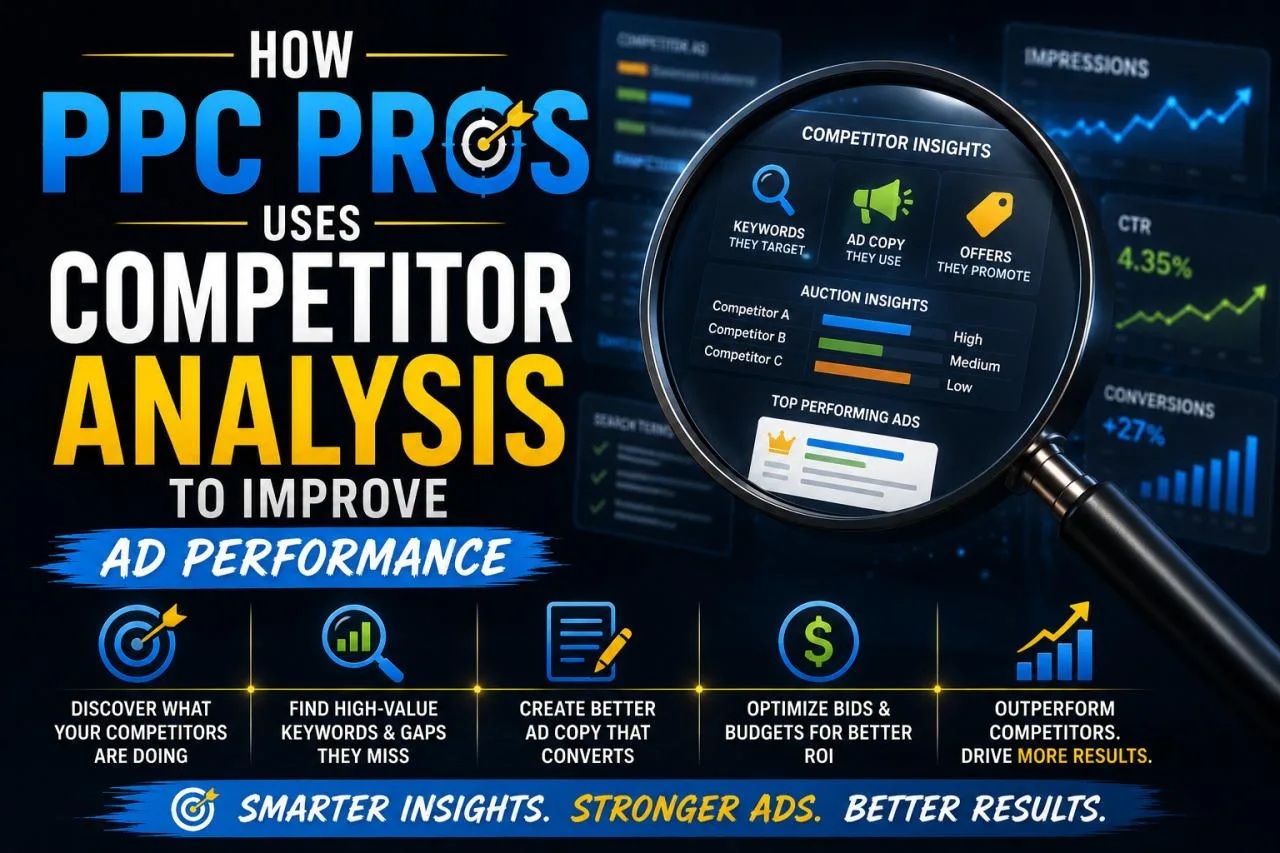
Paid search does not happen in a vacuum.
Every time a business enters a Google Ads auction, it is competing against other advertisers for visibility, clicks, and conversions. Those competitors may be bidding on similar keywords, promoting comparable services, testing different offers, and using landing pages designed to persuade the same audience.
That makes competitor analysis useful, but only when it is approached correctly.
The goal is not to copy another advertiser’s keywords, ads, or landing pages. It is to understand the competitive environment well enough to identify opportunities, avoid obvious weaknesses, and make better decisions about positioning, messaging, bidding, and conversion strategy.
Competitor Analysis Starts With the Search Results
One of the simplest ways to understand a paid search market is to look at what users actually see.
Search the important commercial queries and observe:
-
Which advertisers appear consistently
-
What offers they emphasize
-
How they describe their services
-
Which calls to action they use
-
Whether they mention pricing
-
Which extensions appear
-
How crowded the results feel
This provides immediate context.
A keyword that looks attractive in a planning tool may behave very differently once you see the actual advertisers competing for it.
Not Every Search Competitor Is a Business Competitor
This distinction matters.
A company may compete against another business offline but rarely encounter it in paid search.
At the same time, an advertiser that seems unrelated may appear constantly for the same keywords.
Paid search competitors can include:
-
Direct competitors
-
National brands
-
Marketplaces
-
Lead-generation websites
-
Aggregators
-
Directories
-
Franchises
-
Informational publishers
The competitive set should therefore be based partly on actual search behavior rather than assumptions about the industry.
Competitor Visibility Reveals Market Pressure
If many advertisers consistently appear for the same high-intent terms, that can indicate a competitive auction.
This does not automatically mean the keyword should be avoided.
It means the campaign needs a reason to compete there.
That reason may involve:
-
Stronger economics
-
Better conversion rates
-
More relevant ads
-
Better landing pages
-
Superior offers
-
Geographic advantages
Competitor analysis helps determine whether the business is entering an auction with a realistic strategy.
Auction Insights Can Add Useful Context
Google Ads provides competitive information through features such as Auction Insights when sufficient data is available.
These reports can help advertisers understand metrics related to how often other advertisers appear in overlapping auctions.
Depending on the campaign and report availability, this can provide clues about:
-
Overlap
-
Relative visibility
-
Positioning in auctions
-
Competitive intensity
The information should be interpreted carefully.
Seeing another advertiser frequently does not automatically mean its campaigns are profitable.
Visibility is not the same thing as business success.
Don’t Assume the Biggest Competitor Has the Best Strategy
Large advertisers can spend aggressively.
They can also waste money aggressively.
A competitor appearing everywhere may have:
-
A large budget
-
Broad targeting
-
Weak profitability requirements
-
Strong conversion economics
-
Poor campaign control
You generally cannot know which from the outside.
Competitor activity should therefore generate questions rather than conclusions.
Analyze the Keywords Behind the Competition
Competitive research can help reveal the types of queries attracting advertiser attention.
Look for patterns involving:
-
High-intent service terms
-
Problem-based searches
-
Location terms
-
Competitor brand searches
-
Comparison queries
-
Product categories
The important question is not simply:
“What keywords are competitors bidding on?”
It is:
“Which search intents appear valuable enough to test for our own business?”
Avoid Blindly Copying Keyword Lists
A competitor may bid on a keyword for reasons that have nothing to do with your economics.
Its service margin may be different.
Its geographic coverage may be broader.
Its sales team may convert leads more effectively.
Its customer lifetime value may justify higher acquisition costs.
Copying a keyword without understanding these differences can lead to wasted spend.
Search Terms Often Matter More Than Headline Keywords
Broad keyword research can reveal themes.
Actual search terms reveal what users typed.
This distinction is important because two campaigns targeting the same keyword can attract very different traffic depending on:
-
Match types
-
Negative keywords
-
Bidding
-
Geographic settings
-
Search intent
Competitive analysis should therefore influence search-term strategy rather than becoming a one-time keyword exercise.
Look for Gaps Competitors Are Ignoring
Competitor analysis becomes more useful when it identifies what is missing.
Perhaps most advertisers focus heavily on broad service terms but barely address a valuable specialty.
Maybe they ignore certain locations.
Perhaps their ads say almost exactly the same thing.
Those gaps can create opportunities.
Instead of joining a crowded conversation with identical messaging, a campaign can emphasize something genuinely different.
Compare Ad Messaging
Search advertising provides very limited space.
That makes every claim important.
When reviewing competitor ads, note repeated themes such as:
-
Free estimates
-
Same-day service
-
Experience
-
Discounts
-
Financing
-
Pricing
-
Guarantees
-
Availability
If every advertiser uses the same three messages, another identical ad may struggle to stand out.
Similar Ads Create an Opportunity for Differentiation
Imagine searching for a service and seeing four ads that all say:
Trusted local experts. Free estimates. Call today.
The ads become almost interchangeable.
A stronger strategy may be to communicate a more specific reason to choose the business.
That could involve:
-
A specialized capability
-
A clear process
-
Transparent pricing information
-
Specific availability
-
Relevant experience
-
A genuinely distinctive service feature
The differentiator needs to be true.
Invented advantages create short-term copy and long-term problems.
Competitor Analysis Can Improve Headlines
Advertiser research can reveal which concepts are overused.
Instead of repeating those phrases, marketers can test headlines based on:
-
Customer problems
-
Service specificity
-
Geographic relevance
-
Clear benefits
-
Stronger proof
The goal is not simply to sound different.
It is to make the ad more useful to the person searching.
Offers Deserve Careful Comparison
Competitors may use incentives to increase response.
Examples can include:
-
Discounts
-
Free consultations
-
Free estimates
-
Bundled services
-
Limited-time promotions
Seeing competitors use an offer does not mean you need to match it.
Ask whether the offer fits the economics of the business.
Competing exclusively on discounts can quickly become expensive.
Sometimes Not Discounting Is the Differentiator
Certain businesses can compete on:
-
Quality
-
Expertise
-
Speed
-
Convenience
-
Specialization
-
Customer experience
rather than price.
If competitors are constantly promoting aggressive discounts, there may be room for messaging that emphasizes value instead.
The right approach depends on the market and customer.
Compare Calls to Action
Calls to action provide clues about what competitors believe visitors are ready to do.
Common examples include:
-
Call now
-
Request a quote
-
Book online
-
Schedule service
-
Get started
Different calls to action represent different levels of commitment.
If a complicated service is being marketed with an overly aggressive CTA, a softer entry point may perform better.
Testing matters.
Look Beyond the Advertisement
Clicking competitor ads can provide additional context, but marketers should approach this responsibly and avoid intentionally generating unnecessary paid clicks.
The landing page itself often reveals more than the ad.
Pay attention to:
-
Message continuity
-
Layout
-
Calls to action
-
Forms
-
Trust signals
-
Page speed
-
Mobile experience
-
Content depth
A competitor may have strong ads but weak post-click execution.
That creates opportunity.
Landing Page Relevance Can Be a Major Advantage
Suppose several competitors send every ad to the homepage.
A campaign using highly relevant landing pages may create a more coherent experience.
Someone searching for a specific service should ideally land on a page that directly addresses that service.
The page should quickly answer:
Am I in the right place?
Does this company provide what I need?
Why should I trust them?
What should I do next?
Compare Form Length
Competitor landing pages can reveal different approaches to lead generation.
One may ask only for:
-
Name
-
Phone
-
Email
Another may request 12 fields before submission.
Shorter forms can reduce friction.
Longer forms can sometimes improve qualification.
There is no universal winner.
The right form length depends on the value of the lead and what information the sales team needs.
Mobile Experience Can Become a Competitive Advantage
A competitor may have an impressive desktop landing page that performs poorly on mobile.
This matters because many commercial searches occur on phones.
Check whether important actions are easy to complete on smaller screens.
Look for issues such as:
-
Tiny text
-
Slow loading
-
Difficult forms
-
Buttons that are hard to tap
-
Intrusive pop-ups
-
Important information buried below the fold
A cleaner mobile experience can outperform a more visually elaborate page.
Page Speed Matters More Than Design Awards
A beautiful landing page is not useful if the visitor leaves before it loads.
Competitive research can help identify whether the market has generally weak performance.
If several competitor pages are slow or overloaded, speed can become an advantage.
Campaign optimization should therefore involve both media buying and website performance.
Analyze Trust Signals
Prospective customers often compare several businesses before converting.
Landing pages may use trust signals such as:
-
Reviews
-
Testimonials
-
Certifications
-
Awards
-
Case studies
-
Client logos
-
Years of experience
These can reduce uncertainty when they are legitimate and relevant.
Competitor research can reveal what customers are likely accustomed to seeing.
More Trust Badges Are Not Automatically Better
A page covered in badges, logos, and claims can look less trustworthy if the information feels excessive.
Choose proof that directly supports the customer’s decision.
A strong customer testimonial may be more persuasive than ten decorative icons.
Review Competitor Geographic Strategies
Local campaigns can vary significantly by geography.
Competitors may focus heavily on:
-
Specific cities
-
Suburbs
-
ZIP codes
-
Radius targeting
-
High-income areas
-
Commercial districts
This can reveal opportunities and risks.
An area with little visible competition may represent untapped demand.
Or it may simply have weak demand.
Testing and business data are necessary to determine which.
Don’t Expand Geography Just Because Competitors Do
Another company may profitably serve a location 50 miles away.
That does not mean your business should.
Geographic expansion needs to consider:
-
Travel time
-
Labor
-
Service costs
-
Scheduling
-
Customer value
PPC geography should align with operational reality.
Competitor Brand Campaigns Require Care
Advertisers sometimes bid on competitors’ brand names.
This can create visibility when users search specifically for another company.
However, the strategy requires careful consideration of:
-
Search intent
-
Conversion rate
-
Cost
-
Ad policies
-
Trademark considerations
-
Brand positioning
Someone searching directly for a competitor may be significantly less likely to convert than someone searching for a generic service.
Competitor bidding should be evaluated based on actual performance rather than treated as an automatic tactic.
Negative Keywords Can Be Informed by Competitive Research
Competitor analysis is not only about discovering traffic to pursue.
It can also reveal traffic to avoid.
If certain searches consistently show businesses or services unrelated to your offering, negative keywords may help improve relevance.
This is especially useful when terms have multiple meanings.
Preventing weak clicks can be just as valuable as finding new keywords.
Competitor Analysis Can Improve Budget Allocation
If several competitors appear aggressively around certain queries, the auction may require higher bids or stronger ad quality to compete.
The business should decide whether those searches justify the cost.
Other keyword groups may produce:
-
Lower competition
-
Better conversion rates
-
Better profitability
Budget should follow business results, not prestige keywords.
High CPC Does Not Automatically Mean High Value
A keyword can be expensive because many advertisers want it.
That does not prove it will be profitable for your business.
Evaluate:
-
Conversion rate
-
Lead quality
-
Close rate
-
Revenue
-
Customer acquisition cost
The most expensive keywords are not automatically the most valuable.
Cheap Keywords Can Be Expensive Too
A low-cost click that never generates a qualified customer is still wasted money.
Suppose:
Keyword A: $15 CPC, converts well.
Keyword B: $4 CPC, attracts irrelevant traffic.
Keyword A may ultimately be far more efficient.
Cost per click should never be evaluated in isolation.
Compare Impression Share Carefully
Competitive visibility metrics can help explain why performance changes.
If impression share declines, possible reasons can involve:
-
Budget
-
Ad Rank
-
Competition
-
Bidding
-
Market conditions
Competitor activity may be part of the explanation, but avoid assuming every decline is caused by someone else increasing spend.
Diagnose the account before reacting.
Competitors Can Influence Seasonal Strategy
Competitive behavior often changes around:
-
Holidays
-
Peak seasons
-
Industry events
-
Weather
-
Promotional periods
If competitors significantly increase advertising during certain periods, auctions may become more expensive.
This does not automatically mean you should reduce spend.
Higher competition may coincide with higher customer demand.
The important question is whether the economics remain attractive.
Watch How Competitor Messaging Changes Seasonally
Seasonal ad changes can reveal what businesses believe matters most during different times of year.
For example, messaging may shift from:
Planning and research
to:
Availability and urgency
as customers move closer to purchasing.
This can inspire testing without requiring the business to copy exact language.
Search Competition Can Reveal Market Trends
If multiple advertisers suddenly begin promoting a particular service, it may indicate:
-
New demand
-
New technology
-
Seasonal interest
-
Industry changes
That is worth investigating.
However, competitor activity alone is not proof of a profitable trend.
Use search data and business performance to confirm whether the opportunity is real.
Competitor Analysis Should Include Organic Results Too
Paid and organic results compete for the same user’s attention.
When reviewing a commercial query, look at the complete search results page.
A user may see:
-
Ads
-
Maps
-
Organic listings
-
Directories
-
Videos
-
Other search features
A strong advertising strategy needs to understand what the ad is competing against visually, not only which advertisers are bidding.
Brand Recognition Changes the Auction
A well-known competitor may receive clicks because users already recognize the name.
A smaller business cannot always overcome that advantage by bidding more aggressively.
It may instead need clearer positioning.
Ad copy can emphasize reasons a searcher should consider an unfamiliar company.
Brand building and paid search can therefore reinforce each other.
Reviews Can Influence Paid Search Performance Indirectly
A customer may click an ad, then investigate the business elsewhere before converting.
They may look at:
-
Google reviews
-
Website testimonials
-
Social profiles
-
Search results
Competitor analysis should therefore consider the broader reputation landscape.
An ad does not operate independently from what people discover after clicking.
Strong Competitors Can Make Campaigns Better
Competition is not necessarily bad.
A crowded market can force advertisers to improve:
-
Messaging
-
Landing pages
-
Offers
-
Tracking
-
Follow-up
-
Customer experience
The problem occurs when marketers respond to competition emotionally rather than strategically.
Increasing bids simply because another advertiser appears above you is rarely a complete strategy.
Don’t Turn Competitor Analysis Into Obsession
It is possible to spend too much time watching competitors.
Your own account provides more actionable information.
Priority should generally remain on:
-
Conversion data
-
Search terms
-
Lead quality
-
Sales
-
Customer acquisition cost
-
Revenue
Competitor research provides context.
First-party performance data determines whether changes actually work.
Competitor Analysis Should Generate Tests
The most useful outcome of research is not a document listing what every competitor does.
It is a set of testable ideas.
For example:
Observation: Most competitors emphasize price.
Test: Emphasize specialization instead.
Observation: Competitors send traffic to homepages.
Test: Build service-specific landing pages.
Observation: Most ads use generic CTAs.
Test: Use a more specific next step.
This turns research into optimization.
Test One Variable at a Time When Possible
If you simultaneously change:
-
Keywords
-
Ads
-
Landing page
-
Offer
-
Bidding
and performance improves, it becomes difficult to understand why.
Controlled testing can provide clearer insights.
Real-world PPC accounts are not always perfect laboratories, but disciplined changes are still preferable to constant random adjustments.
Competitor Research Can Improve Ad Extensions and Assets
Search ads can include additional assets that provide more information and occupy more visual space.
Depending on campaign eligibility and available Google Ads features, these may highlight:
-
Services
-
Locations
-
Calls
-
Promotions
-
Additional page links
Reviewing competitor results can reveal whether your own ads are missing useful information.
Use Sitelinks Strategically
Sitelinks can direct users toward important parts of the website.
Potential destinations include:
-
Services
-
Pricing
-
Contact
-
Case studies
-
Locations
If competitors provide several useful navigation options while your ad offers only one generic destination, there may be room for improvement.
Compare Promotional Messaging Carefully
Promotions can improve response, but constant discounts can train customers to wait.
Competitor analysis may reveal a market where every advertiser competes primarily on price.
Before joining that race, determine whether another positioning strategy might produce more profitable customers.
Not every click is worth winning.
Competitor Research Can Improve Qualification
Sometimes the best advertisement is one that discourages the wrong customer.
For example, ad copy can clarify:
-
Service area
-
Business type served
-
Minimum project requirements
-
Product category
Competitor ads may be extremely broad.
More specific messaging can generate fewer clicks but better leads.
That can improve overall efficiency.
Lead Quality Should Guide Competitive Decisions
Suppose a competitor’s aggressive messaging inspires you to increase traffic.
Leads rise by 40%.
But most new inquiries are poor fits.
The campaign has not necessarily improved.
Measure downstream outcomes.
Qualified leads and sales matter more than winning a visibility contest.
CRM Data Can Reveal Which Competitive Keywords Matter
For lead-generation businesses, connecting CRM outcomes with ad data can provide valuable context.
A keyword may generate many form submissions but few customers.
Another may generate fewer leads but more closed sales.
Competitive decisions should eventually be tied to the quality of the business generated.
This Is Where PPC Pros Google Ads Uses Competitor Analysis
In a PPC Pros Google Ads campaign, competitor research can be used as an input rather than a blueprint. Search results, Auction Insights, ad messaging, landing pages, offers, geography, and observed market patterns can help generate hypotheses about where performance might improve.
Those hypotheses still need to be tested against the advertiser’s own conversion data.
The objective is not to become a slightly different version of the competitor.
It is to identify where the campaign can become more relevant, efficient, and persuasive on its own terms.
Competitor Research Should Be Repeated
Competitive markets change.
Businesses launch new offers.
Advertising budgets increase or disappear.
Landing pages are redesigned.
New competitors enter the auction.
A competitive review conducted a year ago may no longer represent the market.
Periodic analysis helps campaigns stay informed without requiring daily monitoring.
Create a Competitive Review Schedule
Depending on campaign size and market volatility, teams might review competitors:
-
Monthly
-
Quarterly
-
Before major seasonal campaigns
-
After unexplained performance changes
There is no universal schedule.
Fast-moving markets may need more frequent attention.
Stable markets may not.
Document What Actually Changes
Avoid relying on memory.
Record meaningful observations such as:
-
New advertisers
-
New offers
-
Messaging changes
-
Landing page changes
-
Seasonal promotions
-
Competitive visibility shifts
Over time, this can reveal patterns rather than isolated events.
Don’t Copy Competitor Creative
Competitor ads can inspire questions.
They should not become templates to reproduce.
Copying another company’s:
-
Headlines
-
Descriptions
-
Designs
-
Landing page copy
does not create differentiation and may create additional problems.
Use research to understand the market, then build original campaigns around your own value proposition.
Your Own Customer Data Is the Strongest Competitive Advantage
Competitors can see many of the same public signals you can.
They cannot necessarily see:
-
Your customer close rates
-
Your strongest services
-
Your profitability
-
Your repeat business
-
Your sales conversations
-
Your customer objections
That first-party information can provide a much stronger competitive advantage than simply watching another advertiser’s headlines.
Talk to Sales Teams
Sales and customer-service teams hear information PPC dashboards cannot show.
They know:
-
Why customers choose the company
-
Why prospects hesitate
-
Which competitors are mentioned
-
Which objections occur repeatedly
-
Which services customers misunderstand
This information can improve ad messaging and landing pages substantially.
Customer Objections Can Become Ad Ideas
If prospects repeatedly ask:
“Do you serve my area?”
geographic clarity may deserve greater visibility.
If they ask:
“Do you handle this specific service?”
service specificity may need improvement.
If everyone asks about scheduling, availability may deserve more attention.
Customer conversations reveal what advertising needs to answer.
Competitor Analysis Works Best With Conversion Analysis
The market tells you what others are doing.
Your conversion data tells you what works for you.
Those two perspectives should work together.
For example:
Competitor research: Most advertisers emphasize same-day service.
Your data: Customers selecting availability messaging convert at a higher rate.
Now there is evidence supporting the positioning.
That is considerably stronger than copying competitors simply because they appear successful.
Don’t Chase Position One at Any Cost
Being the highest ad on the page can feel important.
But profitability matters more than rank.
If achieving maximum visibility requires acquisition costs that no longer make business sense, the campaign should not pursue it simply for prestige.
Sometimes the second or third advertiser can generate more profitable conversions.
Winning Means Profitable Customers
Paid search competition can create the illusion that campaigns are games where the objective is to defeat another advertiser.
It isn’t.
The real goal is to acquire customers at an acceptable cost.
A competitor can receive more impressions, more clicks, and more visibility while your campaign produces better economics.
That is still a win.
FAQs
What is PPC competitor analysis?
PPC competitor analysis involves reviewing the advertisers, messaging, offers, landing pages, search visibility, and other competitive signals surrounding the keywords and audiences relevant to a campaign.
Should businesses copy competitors’ Google Ads keywords?
No. Competitor keyword activity can provide ideas, but each keyword should be evaluated against the advertiser’s own services, economics, geographic coverage, and conversion performance.
What is Google Ads Auction Insights?
Auction Insights can provide information about other advertisers appearing in overlapping auctions when enough data is available. It can help provide competitive context but does not reveal whether another advertiser’s campaigns are profitable.
How often should PPC competitors be reviewed?
The ideal frequency depends on market volatility and campaign size. Periodic monthly or quarterly reviews may work for some businesses, while seasonal or highly competitive markets may justify more frequent analysis.
Can competitor analysis lower Google Ads costs?
Not automatically. However, it may reveal opportunities to improve targeting, messaging, landing pages, qualification, and budget allocation, which can contribute to better overall campaign efficiency.
Final Thoughts
Competitor analysis is most useful when it changes the questions marketers ask.
Instead of:
“How do we copy what the competitor is doing?”
ask:
“Why are they appearing here?”
“What are they emphasizing?”
“What are they overlooking?”
“How does our customer experience compare?”
“Which of these observations are worth testing?”
That approach keeps competitive research grounded in strategy rather than imitation.
The strongest paid search campaigns do not win because they watch competitors more closely than everyone else. They win because they combine market awareness with better targeting, stronger messaging, relevant landing pages, reliable conversion tracking, and a clear understanding of what a profitable customer is worth.
Competitors provide useful context.
Your own customers and performance data should still make the final decisions.